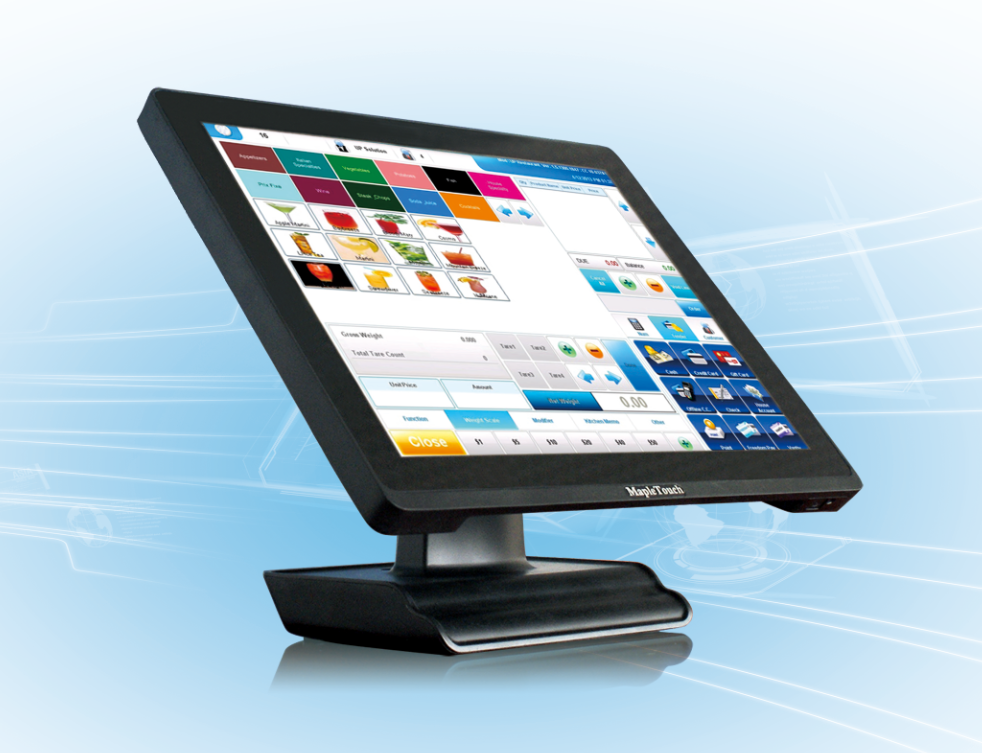
The "All-Round Core" of Efficient Checkout: How POS All-in-One Machines Work
From:
TouchKit Date:03-27 241 Belong to:Industry Trends
A POS (Point of Sale) all-in-one machine is a terminal device integrating hardware integration + software system + data interaction, with the core function of completing commodity transaction settlement, data recording and management. It combines the functions of traditional cash registers, scanners, printers, displays, payment modules and other devices into a single unit. Through the collaboration of software and hardware, it realizes the full-process automation from commodity scanning, price calculation to payment completion and receipt printing.
I. Core Definition: What is a POS All-in-One Machine?
A POS (Point of Sale) all-in-one machine is a terminal device integrating hardware integration + software system + data interaction, with the core function of completing commodity transaction settlement, data recording and management. It combines the functions of traditional cash registers, scanners, printers, displays, payment modules and other devices into a single unit. Through the collaboration of software and hardware, it realizes the full-process automation from commodity scanning, price calculation to payment completion and receipt printing.II. Core Composition: Collaborative Operation of Hardware and Software
1. Hardware Core: "Functional Modules" with Distinct Responsibilities
- Main Control Unit (Motherboard + Processor): Equivalent to the "brain" of the POS machine, it is responsible for running the system, processing transaction data, and coordinating the linkage of various modules to ensure smooth operation response;
- Input Devices: Including capacitive touchscreen (accurately receiving manual operation instructions), barcode scanner/scanning module (identifying commodity barcodes/QR codes and reading commodity information), and keyboard (alternative input method);
- Output Devices: High-definition display (showing commodity prices and transaction details), thermal printer (quickly printing shopping receipts);
- Payment Module: Supports card swiping (magnetic stripe/chip reading), QR code payment (QR code recognition), and NFC near-field payment, enabling multi-channel fund settlement;
- Storage and Communication Module: Built-in hard disk/flash memory stores transaction data, and connects to the network through Wi-Fi/network cable/4G module to synchronize data to the background management system.
2. Software Core: "Intelligent System" Driving the Process
- Operating System: Mostly adopts customized Android or Windows systems to meet the stability requirements of cash register scenarios;
- Cash Register Software: Core functions include commodity inventory management, price calculation, transaction record statistics, and preferential activity verification;
- Data Synchronization Software: Real-time uploads transaction data to the merchant's background, supports inventory early warning and sales report generation, and assists in business decision-making.
III. Workflow: Full Analysis from Scanning to Settlement
- Commodity Identification: Read the name, price and other information corresponding to the commodity barcode through a barcode scanner or manual input on the touchscreen, and display it on the screen synchronously;
- Order Calculation: The cash register software automatically accumulates the total price of commodities, supports automatic calculation of discounts, coupons, member discounts and other rules, and generates the payable amount;
- Payment Settlement: The user selects a payment method (card swiping/QR code/NFC), the payment module verifies the payment information and completes the fund transfer, confirming the successful payment;
- Data Recording and Output: The system automatically records transaction time, commodity details, payment method and other data, the printer synchronously prints the shopping receipt, and the data is synchronized to the background;
- Subsequent Management: Merchants check sales data and inventory remaining through the background system, and perform operations such as restocking and reconciliation.
IV. Core Advantages: Why It Becomes the Mainstream Device for Retail/Catering?
- Integrated design, small space occupation, convenient installation and maintenance;
- Collaboration of software and hardware, efficient transaction process (a single transaction only takes 3-5 seconds);
- Compatible with multiple payment methods to meet the needs of different users;
- Real-time data synchronization helps merchants accurately manage inventory and sales;
- Strong stability, suitable for high-frequency cash register scenarios for a long time (such as peak hours in supermarkets and restaurants).